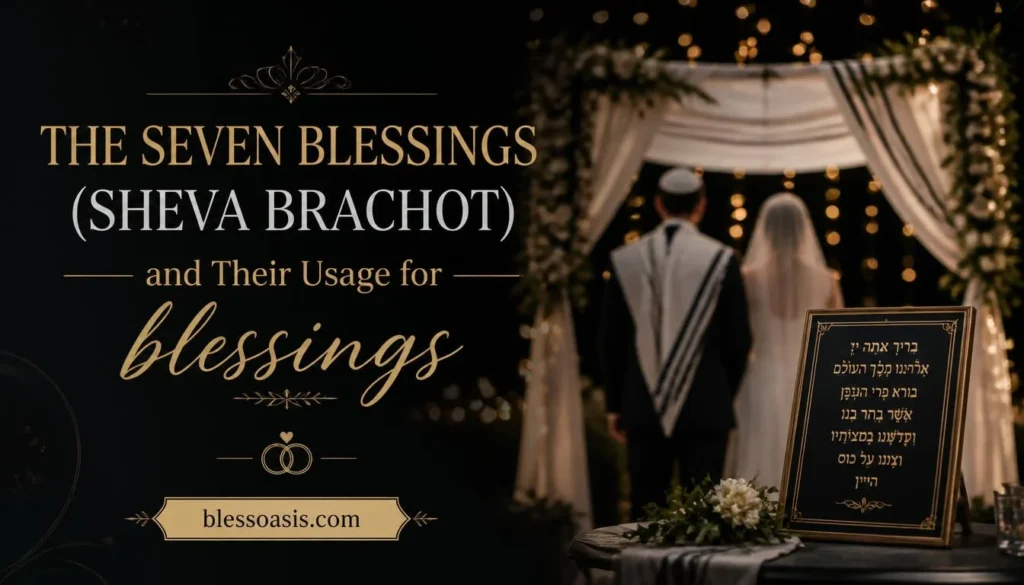
I’ve read a lot of wedding liturgy for BlessOasis. The Sheva Brachot still stands out. Most wedding blessings get written once and used once. These seven are different. They’ve been recited in the same order for close to two thousand years — under the huppah, at the wedding meal, and every night for a week after.
Here’s the thing worth knowing first: the order matters. It moves from wine, to creation, to humanity, to the couple, to Jerusalem, to Eden, and finally to joy. Skip a blessing or swap the order, and you lose that arc.
So this page walks through all seven in that traditional sequence. You’ll get Hebrew, transliteration, and English for each one. We’ll also cover when they’re said and what they mean. And at the end, you’ll find shorter modern well-wishes for guests who want something simpler to say to the couple.
Quick Answer: What You Need to Know
- What they are: Seven blessings (Sheva Brachot) recited over wine during a Jewish wedding ceremony and at meals for the week after.
- When they’re said: Under the huppah near the end of the ceremony, again at the wedding reception, and nightly for seven days following.
- Who recites them: Traditionally the officiant or honored guests — commonly seven different people, one blessing each.
- Language: Chanted in Hebrew, often followed by an English reading for guests.
- Best short takeaway if you only remember one thing: the seventh blessing, about joy, is the one most couples ask a loved one to read aloud in English.
The Seven Blessings (Sheva Brachot), In Order
1. The Blessing Over Wine Baruch atah Adonai, Eloheinu melech ha’olam, borei p’ri hagafen. Blessed are You, Adonai our God, Ruler of the universe, who creates the fruit of the vine.
This opens the sequence the same way Kiddush opens Shabbat. Wine marks the moment as sacred before anything else is said.
2. The Blessing of Creation Baruch atah Adonai, Eloheinu melech ha’olam, she’hakol bara lichvodo. Blessed are You, Adonai our God, Ruler of the universe, who created everything for Your glory.
Short and broad on purpose. Everything that exists, existing for a reason.
3. The Blessing of Humanity Baruch atah Adonai, Eloheinu melech ha’olam, yotzer ha’adam. Blessed are You, Adonai our God, Ruler of the universe, who formed humankind.
4. The Blessing of Human Purpose Baruch atah Adonai, Eloheinu melech ha’olam, asher yatzar et ha’adam b’tzalmo… Baruch atah Adonai, yotzer ha’adam. Blessed are You, Adonai our God, Ruler of the universe, who shaped humanity in Your image, and from that image formed a lasting design so life could continue. Blessed are You, Adonai, who forms humankind.
Blessings three and four sound close in wording. Some guests read them as one. They’re often assigned together.
5. The Blessing for Jerusalem Sos tasis v’tagel ha’akara b’kibbutz baneha l’tochah b’simcha. Baruch atah Adonai, m’sameiach Tzion b’vaneha. May Jerusalem rejoice as her children return to her in joy. Blessed are You, Adonai, who brings joy to Zion through her children.
This is the blessing most people don’t expect at a wedding — a prayer for a city, not the couple. That’s deliberate. Jewish joy, even personal joy, stays tied to communal hope.
6. The Blessing for the Couple’s Joy Sameach t’samach rei’im ha’ahuvim, k’sameichacha yetzircha b’gan eden mikedem. Baruch atah Adonai, m’sameiach chatan v’kallah. Bring joy to these loving companions, the way You brought joy to the first couple in the Garden of Eden. Blessed are You, Adonai, who brings joy to the bride and groom.
7. The Blessing of Complete Joy Baruch atah Adonai, Eloheinu melech ha’olam, asher bara sason v’simcha, chatan v’kallah, gilah rinah ditzah v’chedvah, ahavah v’achavah v’shalom v’rei’ut… Blessed are You, Adonai our God, Ruler of the universe, who created joy and gladness, the bride and the groom, delight, song, pleasure, and happiness, love, harmony, peace, and friendship. May the sound of joy soon be heard again in the cities of Judah and the streets of Jerusalem — the voice of the groom and the voice of the bride, the sound of celebration from every huppah. Blessed are You, Adonai, who brings the groom and bride together in joy.
This last one is the longest by far. It’s usually the one everyone sings together at the end. If you only translate one blessing for a wedding program, make it this one.
When the Sheva Brachot Are Recited
- Under the huppah — near the end of the ceremony, right after the ketubah reading and ring exchange, just before the couple steps away together.
- At the wedding reception — again over wine, following the blessing after the meal. This time, the wine blessing moves to the end instead of the start.
- For seven nights after the wedding — traditionally at a different friend or family member’s home each night. Ten adults need to be present, including someone who wasn’t at the original wedding. These meals are also called Sheva Brachot.
Who Recites the Blessings
In many traditional and Orthodox settings, Jewish men recite the blessings. They’re often honored guests chosen by the couple.
In Conservative, Reform, and other egalitarian communities, anyone the couple wants to honor can recite a blessing. Gender doesn’t matter here.
Most couples split the seven blessings among seven different people — one blessing each, instead of one person reading all seven. Some read in Hebrew. Others read in English.
You don’t need to be fluent in Hebrew. Reading a transliteration or an English translation works just fine.
Modern and Adapted Versions
Some couples ask honored guests to write a personal blessing. They read it instead of, or alongside, the traditional text. This works well for interfaith couples or same-sex couples adapting the language.
Other couples keep the Hebrew exactly as written but add English readings that widen the meaning. Instead of specific references to Zion and Jerusalem, these versions lean into universal ideas of joy and partnership.
Some Orthodox and Conservative communities have also created the Sheva Shevahot, or seven praises. Women recite these before the wedding meal. Each one celebrates a figure from Jewish women’s history.
Modern Jewish Marriage Blessings for Guests
If you’re a guest, you might want something simpler to say or write in a card. These aren’t part of the traditional liturgy. They’re everyday well-wishes in that spirit.
Mazel tov. May your home always be full — of noise, of guests, of second helpings.
May the two of you build something steady together, the way this day was built on generations before you.
Wishing you a marriage with more good ordinary days than remarkable ones. That’s the real blessing.
May your household be one where the door is always open and the table always has room for one more.
Frequently Asked Questions
What does Sheva Brachot mean?
Sheva Brachot is Hebrew for “seven blessings.” It refers both to the seven blessings recited during a Jewish wedding and to the week of celebratory meals that follow it.
When are the seven blessings recited during a Jewish wedding?
Near the end of the ceremony under the huppah, again at the wedding reception, and then nightly for seven days after the wedding at meals held by friends and family.
Do the seven blessings have to be recited in Hebrew?
The traditional text is in Hebrew, but many couples include English readings or transliterations so all guests can follow along or participate.
Can non-Jewish guests recite one of the Sheva Brachot?
Practice varies by community. Some couples invite any honored guest to read an English version, regardless of background. More traditional ceremonies reserve the Hebrew recitation for Jewish participants.
What is the significance of the blessing about Jerusalem?
It ties personal joy to communal hope. That’s a theme found throughout Jewish liturgy. Even at a wedding, the blessings look outward to the community and its history — not only inward to the couple.
Are there modern or same-sex versions of the Sheva Brachot?
Yes. Several organizations and rabbis have published adapted versions with gender-neutral language. Some couples write entirely original blessings inspired by the traditional themes of creation, joy, and partnership.
Key Takeaways
- The Sheva Brachot are seven blessings recited in a fixed, meaningful order — not seven blessings to choose from freely.
- They’re recited at three points: under the huppah, at the reception, and nightly for a week after the wedding.
- Reciters don’t need to be fluent in Hebrew — English readings and transliterations are common and accepted.
- Modern couples often adapt the language while keeping the traditional structure intact.
Conclusion
If you’re preparing a wedding program, the seven blessings above are ready to use. They’re in order, with transliteration included. Or use them as a starting point for the version that fits your ceremony.
For more knowledgeable Blogs…..

Shahzad is the Founder of BlessOasis, a faith-inspired website sharing heartfelt blessings, prayers, wishes, Bible verses, and uplifting messages to bring hope, comfort, and encouragement to readers.