

Watching your granddaughter go through a breakup is hard in a specific way — you remember heartbreak yourself, but you can’t just kiss the pain away like you could when she was small. She needs emotional support now, not just a distraction. Below you’ll find comforting words, heartfelt messages, and conversation starters that come from a grandparent’s voice: warm, a little old-fashioned in the best way, and honest about what actually helps someone heal after a breakup. Whether you’re texting her tonight, writing in a card, or sitting across the kitchen table trying to find the right thing to say, you’ll find something here that fits your relationship with her.
What to Say First (and What to Skip)
Before the messages themselves, a few things matter more than wording when you’re trying to support a heartbroken granddaughter.
What should I avoid saying to a granddaughter after a breakup?
Answer:
Avoid “there are plenty of fish in the sea,” “you’re better off,” or comparing him to past relationships too soon. These minimize her grief even when well-intentioned. Instead, lead with active listening — let her share what happened before you offer perspective or advice.
She’ll likely hear enough opinions from friends and well-meaning relatives. What she needs from you is different: steadiness, patience, and proof that this breakup isn’t the end of her story.
What You Can Actually Do (Not Just Say)
Words matter, but presence matters more. Most advice online stops at “what to say” — here’s what to actually do alongside it.
Show up in small, ordinary ways. You don’t need a grand gesture. Stop by with groceries she didn’t ask for. Invite her over for a meal instead of asking if she wants to talk. Often she’ll open up more easily over chopping vegetables than during a face-to-face “let’s discuss your feelings” conversation.
Give her something to look forward to, not just someone to vent to. A standing Sunday lunch, a walk you take together every week, a movie night — routine gives her something steady to hold onto while everything else feels unstable.
Let her be distracted sometimes. Not every visit needs to be about the breakup. Baking together, watching her favorite show, or just sitting in comfortable silence gives her permission to feel normal for an hour, which is its own kind of healing.
Resist the urge to fix it. You can’t undo the breakup, and trying to problem-solve too early can make her feel unheard. Save the advice for when she asks for it — until then, your job is mostly to stay close and steady.
Watch for signs she needs more than family support. If weeks pass and she’s still not eating, sleeping, or functioning, gently encourage her to talk to a counselor or doctor. Loving support from you is valuable, but it isn’t a substitute for professional help if her grief turns into something heavier.
Short Encouraging Messages and Texts
Good for a quick check-in text when you want her to feel supported without making a big production of it.
- “Thinking of you today. Call me if you want company, or don’t — either way, I love you.”
- “You survived worse than this before I even knew you existed. You’ll get through this, too.”
- “No advice tonight. Just wanted you to know your grandmother’s in your corner.”
- “This hurts now. It won’t always. Healing takes time, and that’s alright.”
- “You don’t have to be okay yet. Just eat something today, alright?”
- “I’m proud of you for how you’re handling this, even the messy parts.”
Heartfelt Messages for a Card or Letter
These take a little more space — good for a note she can keep, reread on hard days, or tuck into a drawer for later.
“I know it feels like the ground moved under you. I’ve been there — long before you were born, but I remember the heartbreak clearly. What I know now that I didn’t know then is this: the people who leave aren’t always the ones who were right for us. Give yourself time to grieve and heal. You’re going to be fine, and probably better than fine.”
“When your grandfather and I were young, I broke off an engagement that everyone thought was a sure thing. I remember feeling like I’d ruined my life. Forty years later, I can tell you it was the best decision I made without knowing it. I’m not saying this breakup will feel that way soon. I’m saying it might, eventually — and I’ll be here through the whole recovery.”
“You don’t need me to tell you that you’re resilient. You already know that. What I want you to hear is that you’re loved exactly as you are right now — heartbroken, exhausted, maybe a little angry. None of that changes how much I love you.”
I wish I could take this pain away from you, I really do. I can’t. So instead I’ll just keep saying it, as many times as it takes: you’re going to be alright. Ask me again tomorrow if you need to hear it twice.”
Real-Life Conversation Examples
Nana: How are you really doing? Not the answer you give everyone else.
Sana: Honestly? Some days I forget for like an hour, and then I remember and it hits all over again.
Nana: That’s a normal part of the healing process. It doesn’t move in a straight line.
Sana: I keep wondering what I did wrong.
Nana: Maybe nothing. Some relationships end because they weren’t right, not because someone failed.
Grandpa: You’ve barely touched your food.
Layla: I’m not really hungry these days. My appetite’s been off since the breakup.
Grandpa: I know. Eat three bites for me anyway. We’ll work up to a full plate.
Layla: (laughs a little) Okay, three bites. Deal.
Nani: I heard about you and Ahmed. I’m sorry, beta.
Zara: Everyone keeps saying sorry like someone died.
Nani: Something did, in a way. It’s alright to grieve the relationship.
Zara: I didn’t think you’d understand that.
Nani: I went through a divorce before I found your grandfather. I understand heartbreak more than you think.
Grandma: So. Tell me everything, or tell me nothing. Your choice.
Priya: I don’t even know where to start.
Grandma: Start with the part that hurts most. We’ll work backward from there.
Encouragement for Different Stages of Heartbreak
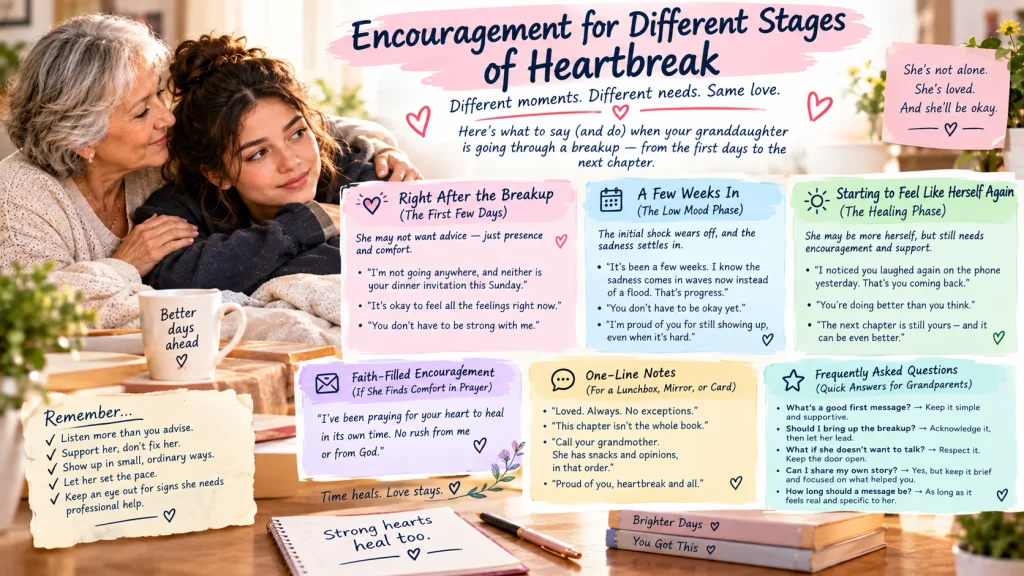
Right after the breakup happens, she may not want advice at all — just presence and comfort. A message like “I’m not going anywhere, and neither is your dinner invitation this Sunday” does more than a paragraph of wisdom.
A few weeks into the recovery process, when the initial shock wears off and low mood settles in, something more direct can help: “It’s been a few weeks. I know the sadness comes in waves now instead of a flood. That’s progress, even if it doesn’t feel like it.”
Further along, when she starts feeling like herself again, encouragement can look forward: “I noticed you laughed again on the phone yesterday. That’s you coming back. I’ve missed that laugh.”
A Few Words for the Faith-Minded
If your granddaughter finds comfort in prayer or faith during difficult times, a gentler line can sit alongside the others without turning the whole message into a sermon: “I’ve been praying for your heart to heal in its own time. No rush from me or from God.”
One-Line Notes for a Lunchbox, Mirror, or Card
- “Loved. Always. No exceptions.”
- “This chapter isn’t the whole book.”
- “Call your grandmother. She has snacks and opinions, in that order.”
- “You are not behind. You are exactly where you need to be.”
- “Proud of you, heartbreak and all.”
Frequently Asked Questions
What’s a good first message to send after hearing about the breakup?
Keep it simple: “Heard about you two. I’m here whenever you want to talk, or just want company.” Don’t lead with questions.
How do I comfort her without seeming to take sides?
Focus on her feelings, not his faults. “That sounds really painful” beats a critique of him, even if she brings it up first.
Should I bring up the breakup or wait for her to mention it?
A short, gentle acknowledgment is usually fine — “I heard, and I’m sorry” — and then let her decide how much further to take it. Some granddaughters want to talk it through in detail right away; others need a day or two before they’re ready, and that’s fine too. Follow her lead rather than your own timeline for how the conversation should go.
What if she doesn’t want to talk about it at all?
Respect that. “No pressure to talk. Just know I’m thinking of you” keeps the door open without pushing.
Is it okay to share my own breakup story?
Yes — kept brief and focused on what actually helped you get through it, not a long comparison between her situation and yours. It tends to land better as a quiet aside than as the centerpiece of the conversation.
How long should an encouraging message be?
Either length works. A short text shows you’re thinking of her; a longer card message gives her something to reread on the harder days.
What can I do besides sending messages?
Show up consistently — a standing meal together, a small errand run, or just sitting with her without an agenda. See the practical support section above for more.
What if she seems to be taking it very hard?
Keep checking in, and gently encourage her to lean on friends, family, or a counselor too. Your support matters a great deal, but it isn’t meant to carry the entire weight by itself — and it’s alright to say that to her directly.
DISCOVER MORE ARTICLES
What to Say to Your Granddaughter Starting College
Graduation Message for Granddaughter
Words of Encouragement for a Granddaughter

Shahzad is the Founder of BlessOasis, a faith-inspired website sharing heartfelt blessings, prayers, wishes, Bible verses, and uplifting messages to bring hope, comfort, and encouragement to readers.